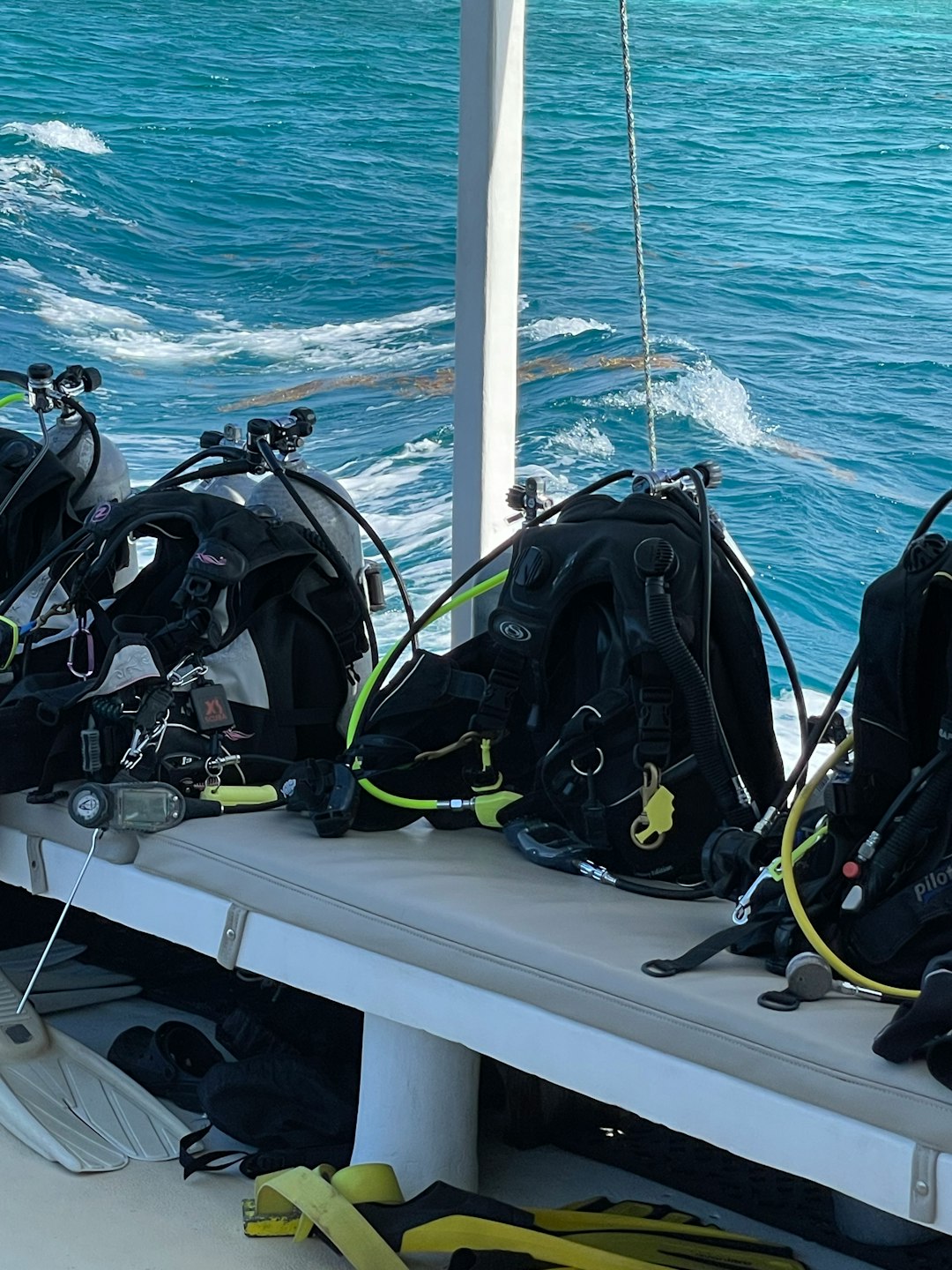
One of the things we want aboard our future Gypsea Bleu catamaran is the ability to dive without depending on a dive shop every time our tanks need to be filled.
That sounds simple enough: buy a scuba compressor, put it on the boat, and go diving.
Except once you start shopping for high-pressure breathing-air compressors, the choices range from tiny units meant mainly for pony bottles to large commercial machines that would be more at home in a dive shop than on a cruising catamaran.
We need something in the middle: small enough for a roughly 40-foot catamaran, powerful enough for our full-size steel tanks, capable of reaching their actual service pressure, properly filtered for breathing air, and practical to run from a cruising boat.
So this is the comparison we are using to figure out what we should actually buy.
Our Tanks Change the Compressor Decision
Kristal and I are not planning around the standard aluminum 80 that many dive operations use. We are looking at Faber high-pressure steel HP100 and HP117 cylinders.
Both are rated to 3,442 psi. That one number immediately eliminates—or at least seriously compromises—some otherwise attractive portable compressors.
| Tank | Rated Capacity | Water Volume | Service Pressure | Diameter | Length | Approx. Cylinder Weight |
|---|---|---|---|---|---|---|
| Faber HP100 | 100 cu. ft. | 12.9 L | 3,442 psi | 7.24 in. | 25.39 in. | 34.3 lb |
| Faber HP117 | 117 cu. ft. | 15 L | 3,442 psi | 8.02 in. | 24.21 in. | 38.9 lb |
The HP117 is interesting on a boat because it carries more gas while actually being a little shorter than the HP100, although it is wider and heavier. Either way, these are substantial cylinders to store aboard a catamaran, and they need a compressor capable of delivering a real high-pressure fill.
Tank specifications referenced from current Faber/retailer data at the time of writing. See Faber high-pressure tank specifications.
The Six Portable Compressors We Are Comparing
The models that keep rising to the top of our research are:
- Mantus Scuba Compressor
- Coltri Icon 100 LSE
- Bauer Junior II
- Nardi Atlantic P100
- Alkin W31 Mariner
- Bauer Oceanus
Portable Scuba Compressor Comparison
| Compressor | Max Pressure | Rated Output | Approx. Weight | Footprint | Motor / Power |
|---|---|---|---|---|---|
| Mantus | 3,000 psi | 35 L/min / 1.2 CFM | 69 lb | 20 × 15 × 19 in. | 110V 13A or 220V 6.5A |
| Coltri Icon 100 LSE | 4,786 psi | 100 L/min / 3.5 CFM | 83 lb | 24 × 14.5 × 15.3 in. | 3 hp / 2.2 kW |
| Bauer Junior II | 5,000 psi | 110 L/min / 3.9 CFM* | 89–165 lb by configuration | 27 × 14 × 17 in. electric | 3 hp / 2.2 kW* |
| Nardi Atlantic P100 | 4,700 psi | 100 L/min / 3.5 CFM | 94 lb | 22.9 × 16.1 × 16.1 in. | 3 hp, single phase |
| Alkin W31 Mariner 3.7 | 5,000 psi | 3.7 CFM / ~105 L/min | 143 lb horizontal | 17 × 32 × 20 in. | 3 hp |
| Bauer Oceanus | 5,000 psi | 139 L/min / 4.9 CFM | 96–135 lb | 27 × 17 × 17 in. electric | 5 hp / 3.7 kW |
*Bauer offers multiple Junior II configurations, including a lower-output 115V version. The table uses the 3 hp / 3.9 CFM electric configuration for comparison.
1. Mantus Scuba Compressor
The Mantus was one of the first compressors that caught our attention because it is clearly designed with cruisers in mind. Mantus describes it as marinized, compact, easy to store, and practical to power aboard a boat.
| Maximum pressure | 3,000 psi / 200 bar |
|---|---|
| Output | 35 L/min / 1.2 CFM |
| Weight | 69 lb |
| Size | 20 × 15 × 19 in. |
| 110V draw | 13 amps continuous |
| 220V draw | 6.5 amps continuous |
What We Like
- Very compact
- Only about 69 pounds
- Low electrical demand compared with the 3 hp compressors
- Designed specifically with marine use in mind
- Can be realistically powered from a modest inverter or generator setup
The Problem for Us
It stops at 3,000 psi.
Our Faber HP100s and HP117s are 3,442-psi tanks. Mantus states that the compressor can fill a full-size tank to 3,000 psi, but that is still not a full rated fill for our cylinders.
It is also much slower. Mantus publishes approximately 60 minutes to fill an 80-cubic-foot tank from empty to 3,000 psi.
Estimated Mantus Fill Times for Our Tanks
| Tank | Empty → 3,000 psi | 500 psi → 3,000 psi |
|---|---|---|
| Faber HP100 | ~76 min | ~64 min |
| Faber HP117 | ~89 min | ~74 min |
Gypsea Bleu verdict: Probably the most boat-friendly compressor in the group, but the 3,000-psi ceiling is a major disadvantage for our high-pressure steel tanks.
Mantus compressor specifications
2. Coltri Icon 100 LSE Stainless
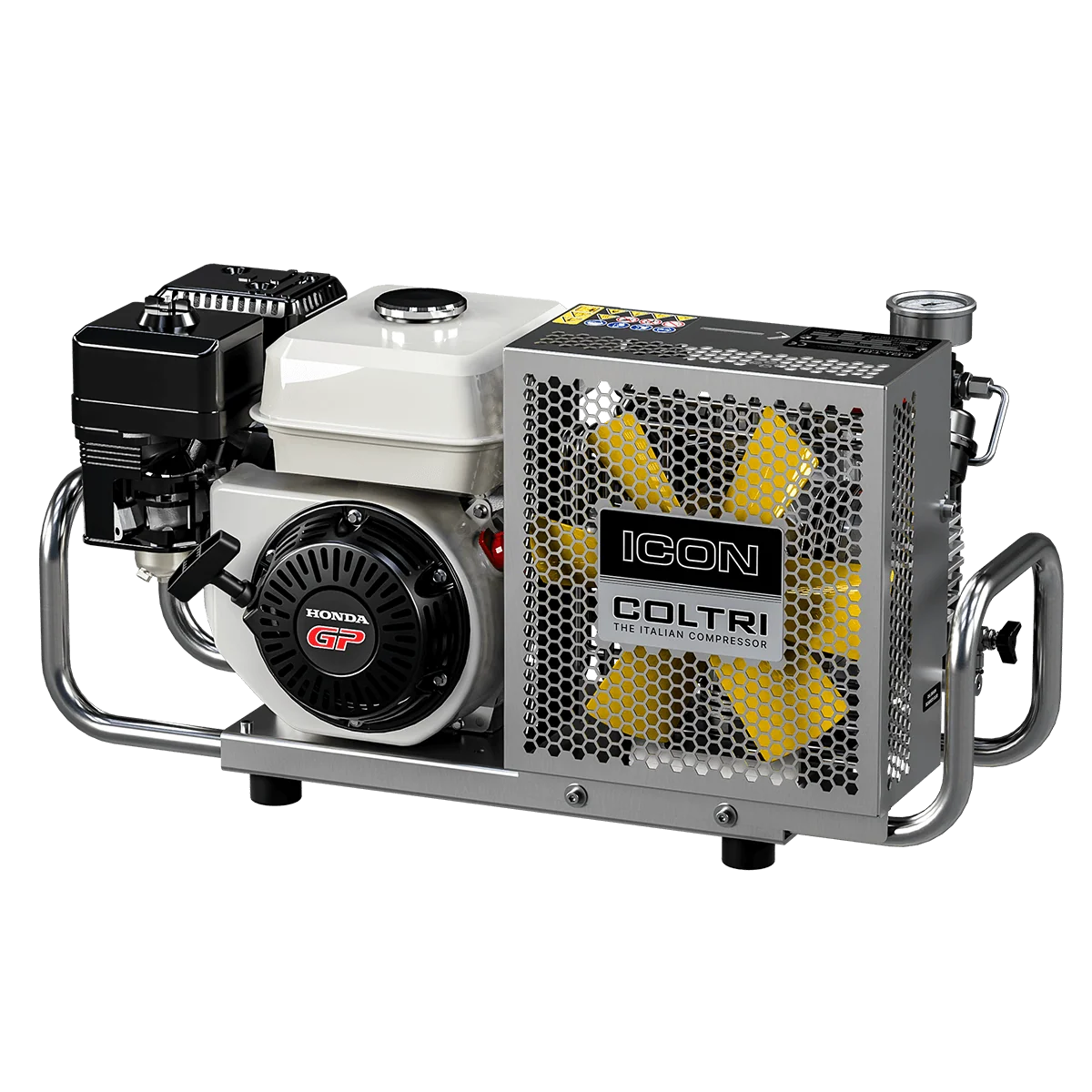
This is where the comparison gets much more interesting for us. The Coltri Icon 100 is still genuinely portable, yet it delivers almost three times the airflow of the Mantus and can comfortably exceed our tanks’ 3,442-psi service pressure.
| Maximum pressure | 4,786 psi / 330 bar |
|---|---|
| Output | 100 L/min / 3.5 CFM |
| Stages | 4 |
| Weight | ~83 lb |
| Size | 24 × 14.5 × 15.3 in. |
| Motor | 3 hp / 2.2 kW |
| U.S. 230V/60Hz version | ~14A |
The stainless-frame version is especially appealing aboard a saltwater boat. Coltri also offers options such as automatic condensate drains, autostop, a pressure-maintaining valve, and a remote suction kit.
Estimated Fill Times
| Tank | Empty → 3,442 psi | 500 psi → 3,442 psi |
|---|---|---|
| Faber HP100 | ~31 min | ~26 min |
| Faber HP117 | ~36 min | ~30 min |
The Electrical Question
The U.S. 230V/60Hz 3 hp Icon 100 is listed around 14 amps. A 115V version also exists, but current Coltri documentation puts that configuration around 29 amps. For our eventual boat electrical system, I would much rather plan around the 230/240V version than try to push a 3 hp compressor through a typical 120V circuit.
Starting surge still matters. The inverter or generator has to start the motor, not simply handle its steady-state running watts.
What We Like
- Full pressure for our HP tanks
- Only about 83 pounds
- Very compact footprint
- Stainless frame available
- Roughly 30-minute HP117 top-offs from normal post-dive pressure
- Proper breathing-air purification
- Marine-friendly options
Gypsea Bleu verdict: Current front-runner. The Icon 100 LSE Stainless looks like the best overall compromise between size, pressure capability, fill speed, and boat practicality.
Coltri Icon LSE specifications
3. Bauer Junior II
The Bauer Junior II is one of the benchmark names in portable breathing-air compressors. The 3 hp electric version produces about 110 L/min / 3.9 CFM and reaches 5,000 psi.
| Maximum pressure | 5,000 psi |
|---|---|
| Output | 110 L/min / 3.9 CFM (3 hp version) |
| Stages | 3 |
| Motor | 3 hp / 2.2 kW (3.9 CFM electric) |
| Electric footprint | 27 × 14 × 17 in. |
| Weight | 89–165 lb depending on configuration |
| Purification | Bauer P0 |
Estimated Fill Times
| Tank | Empty → 3,442 psi | 500 psi → 3,442 psi |
|---|---|---|
| Faber HP100 | ~28 min | ~24 min |
| Faber HP117 | ~32 min | ~28 min |
Bauer also offers a Yachting Package, although that increases the footprint. The company has a long history in breathing-air equipment, which matters when we think about parts and service years down the road.
Gypsea Bleu verdict: Best premium choice. If long-term reputation and service support outweigh a little extra cost and size, the Junior II is extremely attractive.
Bauer Junior II and Oceanus specifications
4. Nardi Atlantic P100
The Nardi Atlantic P100 lands almost directly against the Coltri in this comparison: 3.5 CFM, 4,700 psi, a compact footprint, and about 94 pounds.
| Maximum pressure | 4,700 psi |
|---|---|
| Output | 100 L/min / 3.5 CFM |
| Stages | 4 |
| Power | 3 hp, single phase |
| Weight | 94 lb |
| Size | 22.9 × 16.1 × 16.1 in. |
| Sound | ~79 dB |
Estimated Fill Times
| Tank | Empty → 3,442 psi | 500 psi → 3,442 psi |
|---|---|---|
| Faber HP100 | ~31 min | ~26 min |
| Faber HP117 | ~36 min | ~30 min |
An Important Generator Specification
Nardi specifically recommends a portable power source with approximately 4.5–5 kVA continuous capacity and 7–8 kVA peak starting capability for the Atlantic P100. That is a good reminder that motor startup can be the limiting factor on a sailboat even when the running power looks manageable.
Gypsea Bleu verdict: A strong alternative to the Coltri. We would compare final price, parts availability, and service support before choosing between them.
Nardi Atlantic P100 specifications
5. Alkin W31 Mariner
The Alkin W31 is more substantial. The 3.7-CFM horizontal model reaches 5,000 psi, uses a 3 hp motor, and runs at a relatively low compressor speed.
| Maximum pressure | 5,000 psi |
|---|---|
| Output | 3.7 CFM / ~105 L/min |
| Motor | 3 hp |
| Weight | 143 lb horizontal |
| Size | 17 × 32 × 20 in. |
| Stages | 3 |
| Purifier | P21 refillable system |
Estimated Fill Times
| Tank | Empty → 3,442 psi | 500 psi → 3,442 psi |
|---|---|---|
| Faber HP100 | ~29 min | ~25 min |
| Faber HP117 | ~34 min | ~29 min |
Alkin lists low RPM, refillable purification, and Nitrox-compatible configurations among the W31’s features.
The problem aboard our size of catamaran is weight. At roughly 143 pounds for the horizontal 3.7-CFM version, this stops feeling truly portable. It becomes a permanent boat system.
Gypsea Bleu verdict: Excellent heavy-duty compressor, but probably more machine than two recreational cruising divers need aboard a roughly 40-foot catamaran.
Alkin W31 Mariner specifications
6. Bauer Oceanus
If our priority changes from compactness to speed, the Bauer Oceanus becomes very interesting. Its 5 hp electric version produces about 139 L/min / 4.9 CFM.
| Maximum pressure | 5,000 psi |
|---|---|
| Output | 139 L/min / 4.9 CFM |
| Motor | 5 hp / 3.7 kW |
| Weight | 96–135 lb |
| Electric footprint | 27 × 17 × 17 in. |
| Stages | 3 |
Estimated Fill Times
| Tank | Empty → 3,442 psi | 500 psi → 3,442 psi |
|---|---|---|
| Faber HP100 | ~22 min | ~19 min |
| Faber HP117 | ~26 min | ~22 min |
Those are impressive numbers, but now we are dealing with a 5 hp / 3.7-kW motor and significantly more startup demand.
Gypsea Bleu verdict: Fast, proven, and capable—but probably more electrical load than we want for filling two personal dive tanks on a solar-and-lithium cruising boat.
The Table I Care About Most: Fill Time From 500 PSI
For normal recreational use, we are rarely going to return to the boat with a completely empty tank. A comparison from about 500 psi is much more useful.
| Compressor | HP100 | HP117 | Can Reach 3,442 psi? |
|---|---|---|---|
| Mantus | ~64 min to 3,000 psi | ~74 min to 3,000 psi | No |
| Coltri Icon 100 | ~26 min | ~30 min | Yes |
| Bauer Junior II | ~24 min | ~28 min | Yes |
| Nardi Atlantic P100 | ~26 min | ~30 min | Yes |
| Alkin W31 3.7 | ~25 min | ~29 min | Yes |
| Bauer Oceanus | ~19 min | ~22 min | Yes |
The Mantus comparison is intentionally shown differently because it physically cannot reach the rated pressure of our tanks. That is not a minor specification for us—it is the main reason it falls down the list.
What About Electrical Power on the Catamaran?
This may ultimately matter as much as the compressor dimensions.
We expect our future catamaran to have a substantial lithium bank, solar, an inverter system, and likely generator capability. But compressors are motor loads, and motor startup is very different from running Starlink, laptops, lights, or even many galley appliances.
A compressor with a 2.2-kW motor may demand considerably more power for the brief instant required to start. That means we have to design around:
- Inverter surge capability
- Battery discharge capability
- AC wiring and breaker sizing
- 120V versus 230/240V architecture
- Generator capacity
- Ventilation and cooling
Why I Am Leaning Toward 230/240V
For a 3 hp compressor, 230/240V looks much more sensible aboard our boat. The U.S. Coltri Icon 100 230V/60Hz version is listed at around 14 amps, while the 115V configuration is around 29 amps.
If we know a compressor is part of our future electrical load before we buy the boat or redesign its electrical system, we can build around it correctly rather than trying to make an unsuitable circuit work later.
How Much Battery Energy Does a Fill Use?
A compressor can pull a lot of power without necessarily consuming an outrageous amount of total energy because it only runs for perhaps 20–35 minutes per tank.
A 2.2-kW motor operating for half an hour represents roughly 1.1 kWh of motor energy before inverter losses and real-world inefficiency. Two tank fills could therefore consume a little over 2 kWh in a simplified example.
That is meaningful on a sailboat, but not impossible with a large lithium bank. The larger problem may still be starting the motor.
Electric or Gasoline?
A gasoline-powered compressor avoids much of the inverter issue, but it introduces something we care about even more: exhaust contamination.
The air compressor intake must be located where it cannot ingest carbon monoxide, engine exhaust, generator exhaust, dinghy outboard exhaust, gasoline fumes, cleaning chemicals, paint fumes, or other contaminants.
For a liveaboard catamaran, electric is attractive because the compressor itself does not create exhaust. Even then, we would want a remote intake positioned in genuinely clean air and away from running engines or generators.
How We Would Install a Compressor on Gypsea Bleu
We would not simply throw one in a locker and hope for the best. Our likely installation would include:
- A protected but well-ventilated compressor location
- A remote intake routed to clean outside air
- Separation from engine and generator exhaust outlets
- Good service access
- Dedicated electrical circuit
- Plenty of cooling airflow
- Hour meter
- Maintenance log
- Spare filter cartridges
- Spare intake filters
- Correct compressor oil
- Common service parts and O-rings
- Safe condensate collection and disposal
A high-pressure compressor creates a significant amount of heat. Permanently burying one in a closed, unventilated locker would be a bad plan.
Breathing-Air Quality Is the Most Important Specification
We are not filling tires. We are producing air that we are going to breathe underwater.
That means filtration, compressor maintenance, intake placement, moisture management, and periodic air-quality testing matter every bit as much as fill speed.
Tropical cruising makes this even more important. Hot, humid Bahamian and Caribbean air puts much more moisture into the purification system than cool, dry air. Filter life needs to be treated conservatively and according to the compressor manufacturer’s guidance.
Our plan would be to log compressor hours, maintain the unit carefully, change purification media on schedule, and periodically have the compressor output professionally analyzed for breathing-air quality.
Automatic Condensate Drains: Worth It on a Boat?
I think so.
High-pressure compression removes a surprising amount of moisture. Some portable compressors require frequent manual draining while others offer automatic condensate systems.
Turning a drain valve is not difficult. But aboard a boat, anything that makes a critical repetitive task harder to forget deserves consideration. If we choose the Coltri, an automatic condensate drain is one option I would strongly consider.
What About Nitrox?
Nitrox is useful for repetitive recreational diving, but a breathing-air compressor should never be assumed to be suitable for oxygen-enriched operation simply because it fills scuba tanks.
Mantus states that its compressor is not designed for Nitrox or technical gas blends, while Alkin advertises Nitrox-compatible W31 configurations. Any future onboard Nitrox system would need to follow the specific compressor manufacturer’s oxygen-service requirements and the design of the blending system.
For this comparison, we are evaluating these primarily as breathing-air compressors.
Our Current Ranking for Gypsea Bleu
| Rank | Model | Why |
|---|---|---|
| #1 | Coltri Icon 100 LSE Stainless | Best overall balance of size, weight, full-pressure capability, fill speed, and marine suitability. |
| #2 | Bauer Junior II | Premium choice with excellent reputation, service support, and slightly faster output. |
| #3 | Nardi Atlantic P100 | Very competitive size and output; worth comparing directly against the Coltri. |
| #4 | Bauer Oceanus | Fastest practical option here, but heavier electrical demand. |
| #5 | Alkin W31 Mariner | Heavy-duty, low-RPM machine, but 143 lb makes it harder to justify for our boat. |
| #6 | Mantus | Fantastic boat-oriented design, but the 3,000-psi maximum does not match our 3,442-psi tanks. |
Final Scorecard
| Model | Boat Size / Weight | Power Demand | HP Tank Compatibility | Fill Speed | Our Take |
|---|---|---|---|---|---|
| Coltri Icon 100 Stainless | ★★★★★ | ★★★★☆ | ★★★★★ | ★★★★☆ | Best Overall |
| Bauer Junior II | ★★★★☆ | ★★★★☆ | ★★★★★ | ★★★★☆ | Premium Pick |
| Nardi Atlantic P100 | ★★★★☆ | ★★★☆☆ | ★★★★★ | ★★★★☆ | Strong Contender |
| Bauer Oceanus | ★★★☆☆ | ★★☆☆☆ | ★★★★★ | ★★★★★ | Fastest Practical Option |
| Alkin W31 | ★★☆☆☆ | ★★★☆☆ | ★★★★★ | ★★★★☆ | Heavy-Duty Pick |
| Mantus | ★★★★★ | ★★★★★ | ★★☆☆☆ | ★★☆☆☆ | Best for 3,000-psi / Smaller Tanks |
What Would We Buy Today?
If I had to order the compressor today for our future catamaran, my current choice would be:
Coltri Icon 100 LSE Stainless, 230V/60Hz
Not because it is the fastest. Not because it is the biggest. And not because every other compressor is wrong.
It simply appears to hit the sweet spot for our use.
- Small enough for a cruising catamaran
- About 83 pounds
- Full 3,442-psi fills for our Faber tanks
- Roughly 26–30 minute normal top-offs
- Stainless frame available
- 230V configuration that we can account for when designing the boat’s electrical system
The Bauer Junior II would be right behind it. If we found a good price on a Junior II—particularly a well-maintained unit with known history—it could easily change the decision.
And that is where we are today.
By the time Gypsea Bleu is sitting at anchor in clear Bahamian water with two big steel tanks strapped down and a compressor humming away, we may have learned enough to change our minds again.
That is part of the reason we’re documenting all of this.
There is a big difference between reading a specification sheet at home…
…and filling two HP117s at anchor after an incredible morning dive.
That’s the test that actually matters.
From Blue Water to Hidden Treasure — Gypsea Bleu
A Note on the Fill-Time Tables
Fill times in this article are approximate calculations based on cylinder water volume, pressure change, and manufacturers’ published rated output. They are useful for comparing compressors, but they are not guaranteed real-world fill times. Ambient temperature, inlet conditions, pressure, cooling, cylinder temperature, and compressor performance can all change actual results.
Safety Note
High-pressure breathing-air compressors are life-support equipment. Intake-air placement, filtration, condensate management, maintenance, installation, and breathing-air testing should follow the compressor manufacturer’s instructions and applicable breathing-air standards. Never place a compressor intake where it can ingest engine or generator exhaust.